The Intersection of Mathematics and Art: A Q&A with Associate Professor Clayton Shonkwiler


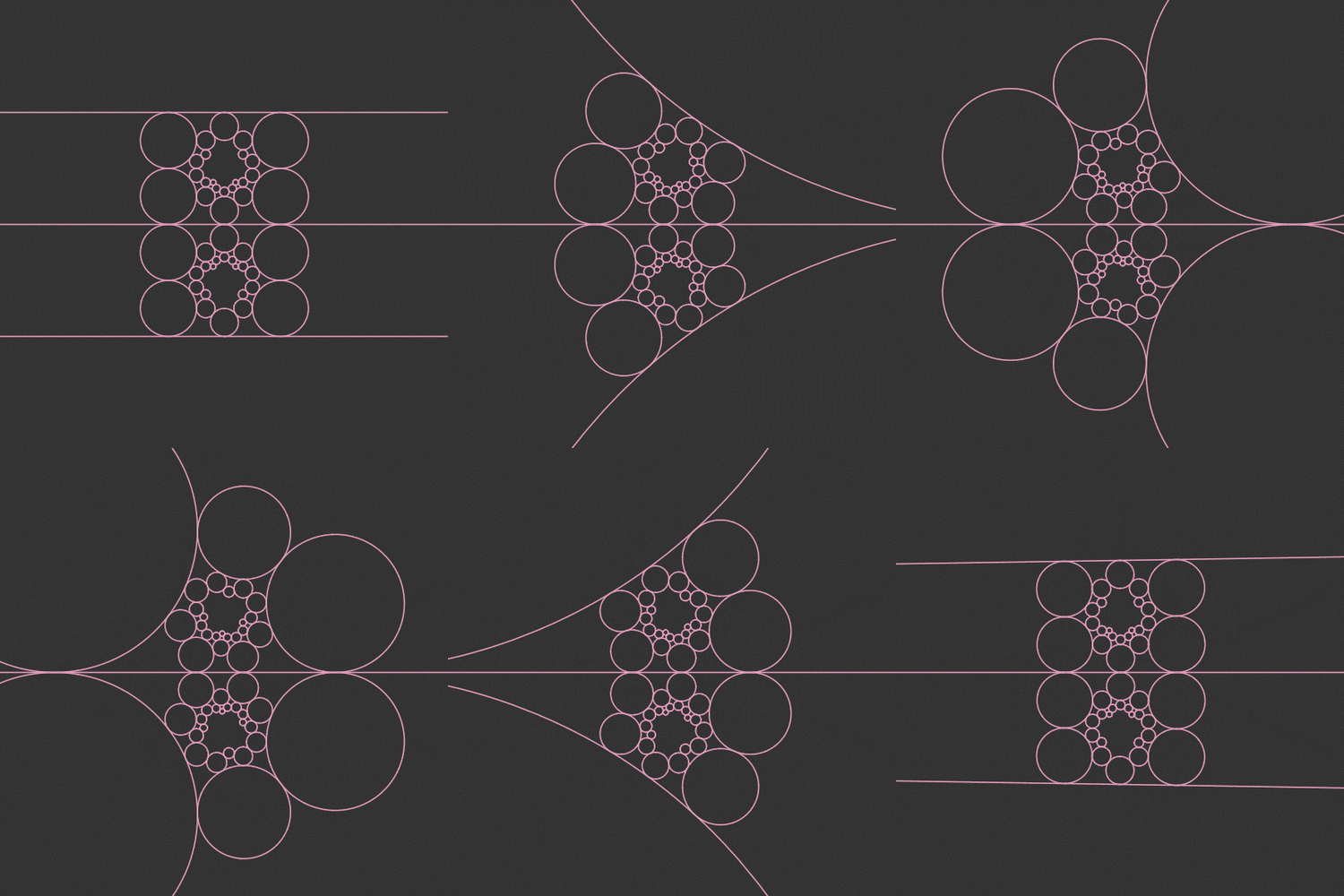

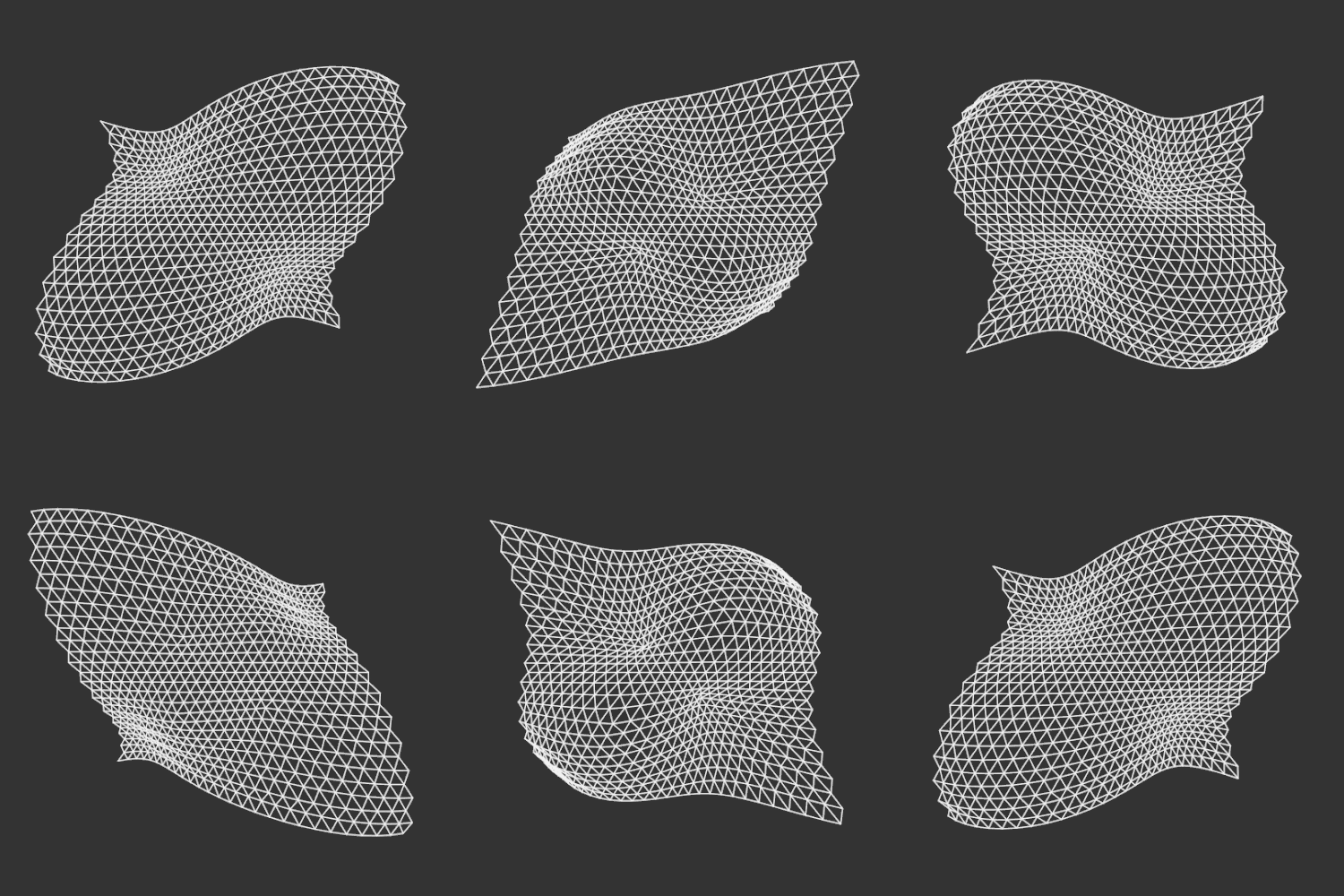
While trying to illustrate a point in a lecture, Associate Professor Clayton Shonkwiler of mathematics created his first mathematics animation. Now, years and hundreds of GIFs later, Shonkwiler’s math-inspired artwork has become a dedicated hobby, leading to art exhibitions and innovative teaching curriculum.

What is your background in mathematics?
My training is in differential geometry, which, for example, is the math behind general relativity, and so the idea there is to understand the shape of spaces. These days I call myself an applied geometer: I work with a physical system that someone is interested in and take all the possible states of that system and think of those as points in the space. The goal is to understand the geometry of that space, which in turn gives us information about the system.
How did you discover your interest in mathematics inspired art?
The first animation that I made was to just try to illustrate something for a research talk, and I realized “Oh, I can actually make something that will show the audience what I am talking about.” From there I realized that I could create anything that I wanted.
How has your work in mathematical art evolved from that first animation to now?
When I was a postdoctoral researcher, I was asked to cover a class for one of the faculty members on the topic of Euclidean and non-Euclidean geometry. That day the course was going to talk about the hypersphere, and I thought that I could make an animation to illustrate what this is. The students thought it was cool and wanted to know more about how I did it.
My interest evolved from there; I spent the next couple of years thinking about what random mathematical concepts I could turn into animations. I started posting these online and saw interest from viewers who liked them.
Eventually, I submitted art to exhibitions at the Bridges Conference, which is run by the primary math art group the Bridges Organization, and the annual Joint Mathematics Meeting hosted by the American Mathematical Society. My work was selected by juries and displayed at those conferences several times.
I have also had my artwork accepted into GIF exhibitions at the Boulder Museum of Modern Art and the Electronic Language International Festival, FILE, in Brazil.
How has mathematical art influenced your teaching and your students?
I use a lot of animations when I teach, especially in the undergraduate differential geometry course and when I teach complex analysis. Having animations as a resource to show students a moving picture of what they are reading about in the textbook is a very valuable learning tool. That has had a big influence on how I teach.
A lot of recent animations have grown out of something I was trying to explain in the complex analysis course. I now have a library of animations that I can source from to teach these courses, and then inevitably the course discussion will lead to a new idea for an animation, and this creates a nice feedback loop.
Tell me more about how this applies to geometry and real-world problem solving.
One of the big things that I think about these days is the chemical composition of polymer models. This is something that I have worked on for over a decade now. When a polymer forms a loop, it becomes a complex shape because you have added a constraint that you have to get the end back to the beginning after some number of steps.
What I do is look at this space and all the possible configurations of the loop with n edges in it. I try to answer how we can generate random outcomes or compute expected values. This process uses an idealized model that acts as a first approximation that is easy to compute. The idea is to develop models that you can compute with on your laptop and make a first pass of what we expect to happen. Then, a materials scientist or polymer scientist can take the most promising outcomes, put it on a supercomputer, and do a molecular dynamics simulation. These very idealized mathematical models account for 70-80% of what you see in the supercomputer – you can run it on your laptop in a few seconds vs. a supercomputer which would take hours and be much more expensive.